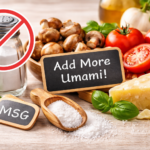
Glutamate is a molecule. It is an amino acid, and your body uses it to build proteins. It also plays a second role: it creates the taste we call umami.
You find glutamate in many everyday foods. Tomatoes contain it. Mushrooms contain it. Cheese, especially aged cheese like parmesan, contains a lot of it. Meat and broths release it as they cook. When you taste a deep, savory flavor in these foods, you are tasting glutamate.
Monosodium glutamate, often called MSG, is a specific form of glutamate. It is made by combining glutamate with sodium. This pairing creates a stable, crystalline ingredient that dissolves easily and delivers a clean, consistent umami taste.
At a molecular level, the key part is the same. Both glutamate in food and glutamate in MSG activate the same receptors on your tongue. Your body does not treat them as different signals. Once MSG dissolves in water or in your cooking, it separates into sodium and free glutamate. That free glutamate is what your taste receptors detect.
The main difference, then, is form and control. Glutamate in whole foods is bound up within the structure of the food, and it releases as you cook, age, or ferment ingredients. MSG is already in its free form, so it delivers that umami taste immediately and predictably.
The way MSG is made is also grounded in simple biology. Producers start with plant-based ingredients like sugarcane or corn. They use a fermentation process, similar to how yogurt or soy sauce is made. Microorganisms convert sugars into glutamic acid. After fermentation, the glutamic acid is purified and combined with sodium to form monosodium glutamate, which is then crystallized and dried into the familiar white granules.
In your kitchen, you use both forms, often without thinking about it. When you cook down tomatoes, you concentrate natural glutamate. When you simmer bones into broth, you release more of it. When you add a pinch of MSG, you add free glutamate directly. In each case, you are building the same core taste.
For home cooks, this leads to one clear idea: glutamate is the source, and MSG is a tool. Both create umami. Both deepen flavor. The difference is how quickly and how precisely you bring that flavor into your food.